Product mockup prompts for Midjourney work best as a visual brief: name the object, its material, the scene and the framing. A reference image can guide the result, but Midjourney says references inspire a new image rather than reproduce the original exactly. Use a generated scene for a concept or moodboard; check the actual product’s geometry, packaging and text separately before treating it as an accurate mockup.
The templates below are original starting points, based on Midjourney’s Prompt Basics, Image Prompts and Style Reference documentation. They are proposed prompts, not examples of tested outputs.
On this page
Decide what the mockup must show
Write down the details that make this object recognisable: one bottle or two, cylindrical or rectangular, matte paper or translucent glass, a plain label or no label. Then choose the surface and camera position. A bottle on a stone shelf and the same bottle in a top-down packing layout need different descriptions.
Midjourney’s prompting guide recommends short, clear descriptions rather than long lists of instructions. It also recommends specific numbers when the number of objects matters. That makes “one amber glass bottle” a more useful starting point than “several beautiful products.”
A compact structure is:
[object and quantity], [material and finish], [surface or setting],
[lighting], [camera view], [visual medium]
Keep the important product details near the beginning. Add decoration only after the brief clearly describes the object.
Packaging and bottle templates
For a restrained packaging concept:
One unbranded rectangular cardboard carton, pale terracotta paper,
small blank cream label, standing on a warm ivory studio sweep,
soft side lighting, three-quarter view, product photography
For a glass bottle concept:
One cylindrical amber glass bottle with a black screw cap,
blank rectangular paper label, on a pale limestone shelf,
diffused window light, front-facing close-up, product photography
For a collection layout:
Three unbranded skincare containers: one tall pump bottle,
one short glass jar, one folded paper carton, neutral cream finishes,
arranged on a flat beige surface, overhead view, soft studio light
Replace materials and shapes with the ones in your brief. The examples deliberately avoid real brand names and do not ask Midjourney to recreate a competitor’s packaging. A blank label is space for later artwork, not a promise that the model will produce a label with exact dimensions.
If a scene looks attractive but the lid, neck or base changes shape, revise the object description before adding more style language. An atmospheric image can still misrepresent the product.
Stationery and digital-display concepts
For printed stationery:
Two unbranded business cards on textured off-white paper,
one face up and one face down, blank central artwork area,
overlapping on a dark charcoal desk, soft overhead light,
top-down product photograph
For a poster display:
One vertical blank cream poster inside a slim black frame,
against a warm grey plaster wall, subtle window shadow,
straight-on architectural photograph
For a device scene:
One unbranded tablet with a blank pale screen on a wooden desk,
notebook beside it, restrained morning light,
three-quarter product photograph
These are scene concepts. If an interface, print design or legal label must be exact, prepare that artwork separately and check it in the final composition. Do not use a generated display as evidence that a product has a feature or that a real campaign ran.
Use an Image Prompt for the object or composition
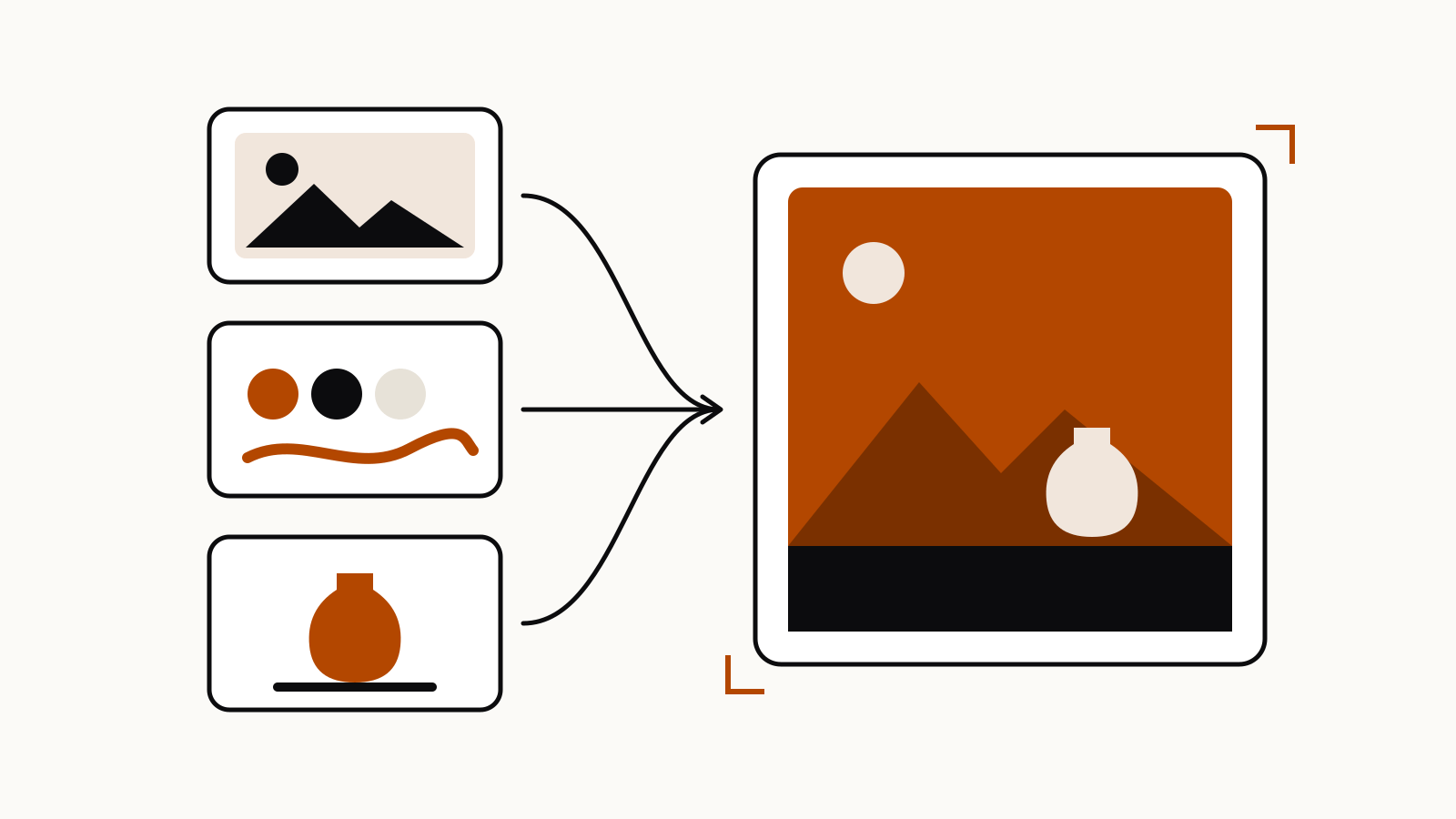
Midjourney says an Image Prompt influences content, composition and colour. On the website, open the image panel from the Imagine bar, upload or choose an image, and add it as an Image Prompt. In Discord, place the image URL before the text description.
Use a photograph or design you have the right to use. The text should describe the complete desired result rather than tell Midjourney how to modify the reference. For example, describe “one amber bottle on limestone, front-facing” rather than “change the background of this image.”
The Image Prompts guide recommends cropping the reference to match the intended output aspect ratio. It accepts files ending in PNG, GIF, WebP, JPG or JPEG. A single image needs accompanying text; image-only prompts require multiple images.
A reference is not a product-fidelity lock. Midjourney explicitly directs users who need precise changes to their own images to its Editor.
Use a Style Reference for the campaign’s look
A Style Reference transfers visual qualities such as colour, texture, medium and lighting. Midjourney says it does not copy the reference’s objects or people. Use it when the scene should resemble an approved visual direction, rather than when the bottle itself must match a photograph.
On the website, place the image in the Style Reference section. In Discord, add --sref followed by its image URL at the end of the prompt. The documentation recommends a simple content description and avoiding style words that conflict with the reference.
For a series, keep the object brief consistent and change only the scene detail you need. Record the reference and prompt alongside each concept so revisions are traceable. This is a way to organise the work; it does not guarantee identical objects across generations.
Review the concept against the real brief
Before handing over a mockup, compare the result with the supplied product information: quantity, shape, closures, materials, label position and perspective. Check any added lettering and accessories. A generated extra component should not become an implied product claim.
For more general prompt construction, see Image prompts. If you need to adjust generation settings, use the Midjourney parameters cheat sheet, then recheck the relevant version’s official documentation.